
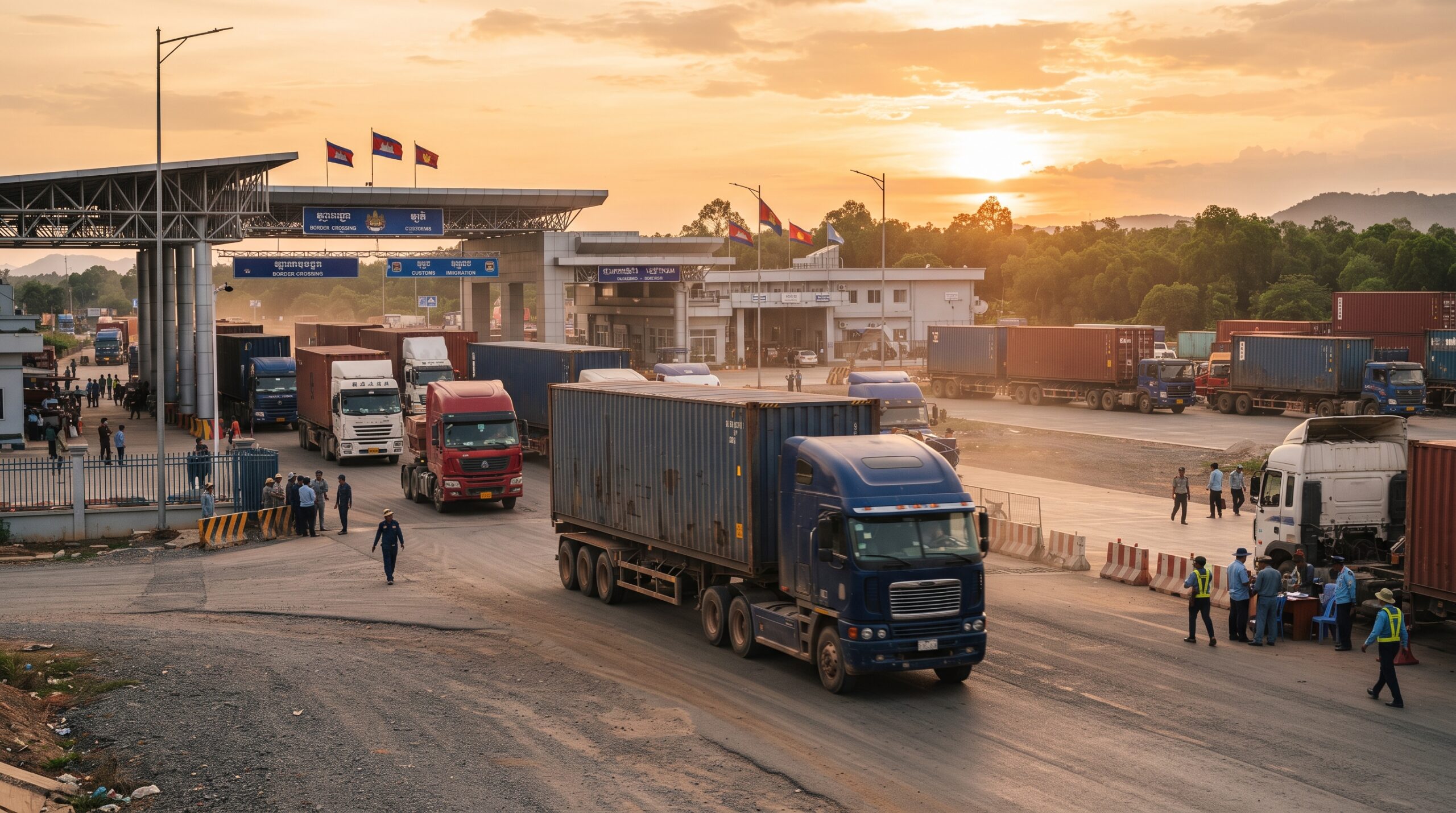
Regional trade can feel distant until a factory order, a border delay, or a new tariff rule hits your margins. For Cambodia, ASEAN is not a slogan on a summit banner. It is a growing share of cargo, contracts, and supply-chain decisions that shape jobs from garment floors to farm gates.
Cambodia is strengthening trade ties with key ASEAN partners through higher regional volumes, deeper links with Vietnam, and wider use of ASEAN and RCEP frameworks. Official figures for 2026 show double-digit growth in ASEAN trade compared with the prior year. If you export, import, invest, or advise clients on the Kingdom’s economy, the shift is practical: more of Cambodia’s commercial future is being written next door.
The Numbers Behind the Regional Push
Cambodia’s trade with ASEAN member states reached about $10.3 billion in the first half of 2026, up roughly 21.8 percent year on year, according to Ministry of Commerce reporting. Through the first seven months, regional trade climbed to about $11.68 billion, a gain near 20.7 percent from the same period a year earlier. ASEAN accounted for roughly a quarter to 27 percent of Cambodia’s total foreign trade in those windows, depending on the exact reporting period.
Exports to ASEAN held steadier than imports in some monthly cuts, while imports from the bloc rose faster as manufacturers pulled in inputs. That pattern is common for an economy assembling and processing goods for both regional and global buyers. The headline is not only growth. It is concentration of opportunity inside a neighborhood Cambodia can reach by road, river, and short-haul logistics.
Where the Goods Go and What Moves
Main export lines in regional trade still include garments, footwear, travel goods, electronics-related items, tyres, solar panels, and agricultural products such as rice, cashew, rubber, cassava, durian, and bananas. Imports reflect industrial demand and consumer markets. If you run a sourcing team, the list tells you where Cambodia sits in ASEAN value chains: competitive in labor-intensive finished goods and selected agri-exports, still hungry for intermediate inputs.
Vietnam: Cambodia’s Heaviest ASEAN Trade Lane
Vietnam remains Cambodia’s largest ASEAN trading partner and one of its most important overall partners after major global markets. Bilateral flows have run in the multi-billion-dollar range on a quarterly and year-to-date basis in 2026, with periods showing improved balance for Cambodian exports. Cross-border economic talks have stressed infrastructure, customs facilitation, and production linkages rather than ceremony alone.
Leaders have highlighted projects such as faster road links between Ho Chi Minh City, Moc Bai, Bavet, and Phnom Penh, plus interest in special economic and border-zone cooperation. For logistics managers, that agenda matters more than communiqué language. Time at the border is a cost line. Predictable clearance and better roads turn “nearshore ASEAN” from a slide deck into a delivery schedule you can sell to buyers.
Practical Angle for Exporters
If you ship agri-products or light manufactures, Vietnamese demand and transit routes can diversify reliance on any single overseas market. Track phytosanitary rules, seasonal gluts, and quality specs as carefully as tariff preferences. Regional buyers are close. They are also exacting when alternative suppliers sit one border away.
Singapore, Malaysia, Thailand, and Indonesia in the Mix
Beyond Vietnam, Cambodia’s top ASEAN partners typically include Singapore, Thailand, Malaysia, and Indonesia. Singapore often appears prominently in trade statistics because it functions as a finance, transshipment, and commercial hub, not only as a final consumer market. Malaysia ties have strengthened on both trade and investment narratives, with bilateral trade reported around RM5 billion in 2025 and continued political engagement in 2026.
Thailand remains a consequential neighbor for energy, inputs, and border commerce, though flows can be sensitive to political and border conditions. Indonesia adds scale as a large ASEAN economy with room for niche Cambodian exports and partnership in selected sectors. A balanced ASEAN strategy does not mean equal volume with every member. It means deliberate exposure to hubs, neighbors, and large consumer bases.
RCEP as a Force Multiplier
ASEAN integration sits alongside the Regional Comprehensive Economic Partnership, which has accounted for a dominant share of Cambodia’s total trade in recent reporting—often around three-fifths or more. China, Japan, and Korea sit in that wider circle, but ASEAN members are embedded in the same preference network. Firms that learn rules of origin once can often apply them across multiple preferential routes. Training your documentation team on certificates of origin is one of the highest-return “trade policy” moves a mid-sized exporter can make.
Connectivity, Chambers, and the Soft Infrastructure of Trade
Hard infrastructure—ports, roads, canals, and border checkpoints—sets the ceiling on volume. Soft infrastructure sets the floor on trust. Cambodia’s private sector has used business forums, chamber partnerships, and outbound representative offices to match buyers and investors. Events such as ASEAN-focused business summits in Phnom Penh put manufacturers in the same room as regional purchasers who will never see a cold email.
Customs modernization, digital documents, and clearer investment facilitation matter as much as ribbon-cuttings. When we talk with operators who succeed regionally, they cite fewer surprise fees, faster responses on standards, and relationships that survive a missed shipment. Policy can open a gate. Firms still have to walk through it with competitive quality and reliable lead times.
What Investors Watch
Investors reading Cambodia’s ASEAN story look for stable rules, electricity reliability, skilled supervisors, and logistics that do not erase wage advantages. Special economic zones and border-area concepts are only as strong as the services inside them. If you evaluate a site near Bavet or another gateway, model clearance times and trucking variability, not only rent per square meter.
Opportunities and Frictions You Should Plan For
Opportunities include supplier diversification for global brands, agro-exports into regional supermarket and processing channels, and component roles in electronics or renewable-energy hardware where orders are expanding. Frictions include non-tariff barriers, uneven standards enforcement, seasonal transport bottlenecks, and competition from other low-cost ASEAN producers. A preference under AFTA or RCEP does not erase the need for consistent product quality.
Currency movements, fuel prices, and partner-country demand cycles will still swing order books. Firms that treat ASEAN as one market often stumble. Firms that treat it as ten regulatory environments with shared frameworks adapt faster. Build a simple matrix: product, target ASEAN market, applicable preference claim, required standards, and logistics path. Update it quarterly.
Action Checklist for Cambodian SMEs
Map your top three ASEAN buyer countries by realistic demand, not aspiration. Confirm whether your product qualifies for preferential tariffs and what origin paperwork is required. Price landed cost to Ho Chi Minh City, Bangkok, or Port Klang, not only FOB Phnom Penh or Sihanoukville. Attend one serious matchmaking forum this year with samples ready. Assign one staff member to monitor Ministry of Commerce notices and partner-country standards updates. Small disciplined steps compound faster than a generic “go regional” slogan.
Risks of Over-Concentration—and How to Stay Balanced

Stronger ASEAN ties reduce distance risk. They do not remove concentration risk. If imports from the region surge faster than higher-value exports, the trade balance can widen even while integration deepens. If one border corridor dominates, disruption there hits harder. Pair regional growth with continued access to large external surplus markets and ongoing product upgrading so Cambodia captures more value per container, not only more containers.
Policy continuity, transparent customs practice, and skills development will decide whether 20 percent trade growth becomes a temporary spike or a durable base. Readers in government and industry associations can help most by translating agreements into firm-level guidance in Khmer and plain English, with working examples of origin rules for common export lines.
A Note on Reading Summit News
Summit language will always outrun shipment data. When you see announcements about new cooperation, look for follow-through metrics: trade volume by partner, number of preference claims used, average border clearance times, and investment projects that reach operation. That habit separates strategic narrative from operational reality—and it keeps your own planning honest.
FAQ
How much trade does Cambodia do with ASEAN?
In the first half of 2026, ASEAN trade was reported around $10.3 billion, up about 21.8 percent year on year, with further gains through the first seven months.
Which ASEAN country is Cambodia’s top regional partner?
Vietnam is consistently the largest ASEAN trading partner for Cambodia by volume.
What does Cambodia export within ASEAN?
Key lines include garments, footwear, travel goods, selected industrial products, and agricultural goods such as rice, cashew, rubber, and fruit.
How does RCEP relate to ASEAN trade?
RCEP includes ASEAN members and major regional partners. It has accounted for a large share of Cambodia’s total trade and complements ASEAN frameworks.
Why is cross-border infrastructure with Vietnam important?
Faster roads and clearer border procedures cut logistics time and support production linkages between the two economies.
Is this a good time for SMEs to target ASEAN buyers?
Growth figures are encouraging, but success still depends on standards compliance, origin documentation, and reliable delivery—not only preferential tariffs.
Is this article investment advice?
No. It is journalistic and educational analysis based on reported trade figures and policy trends. Verify data with official sources before making commercial decisions.
Use the Region—Do Not Only Praise It
Cambodia’s stronger trade ties with key ASEAN partners show up in the ledger: higher regional volumes, Vietnam-centered corridors, and active use of ASEAN and RCEP pathways. The upside is proximity and diversified demand. The work is standards, logistics, and origin compliance that turn preference tables into paid invoices.
If you trade Cambodia-linked goods, revisit your ASEAN partner mix this quarter. Check the preference claims you underuse. Walk one border process in person if you can. Regional integration rewards operators who treat it as an operations project—not a press release.


Leave a Reply