
You touch a length of hand-woven Cambodian silk, and the fabric instantly feels different from mass-produced textiles—it carries a subtle, organic crispness, a shimmering play of shifting colors, and the invisible weight of centuries of human patience. It is an extraordinary sensory experience for modern travelers and art collectors who assume that all luxury fabrics roll off automated factory assembly lines.
That persistent fear that machine-made uniformity has erased true artisan craftsmanship misses the deeply sacred, living tradition preserved across rural Cambodian villages.
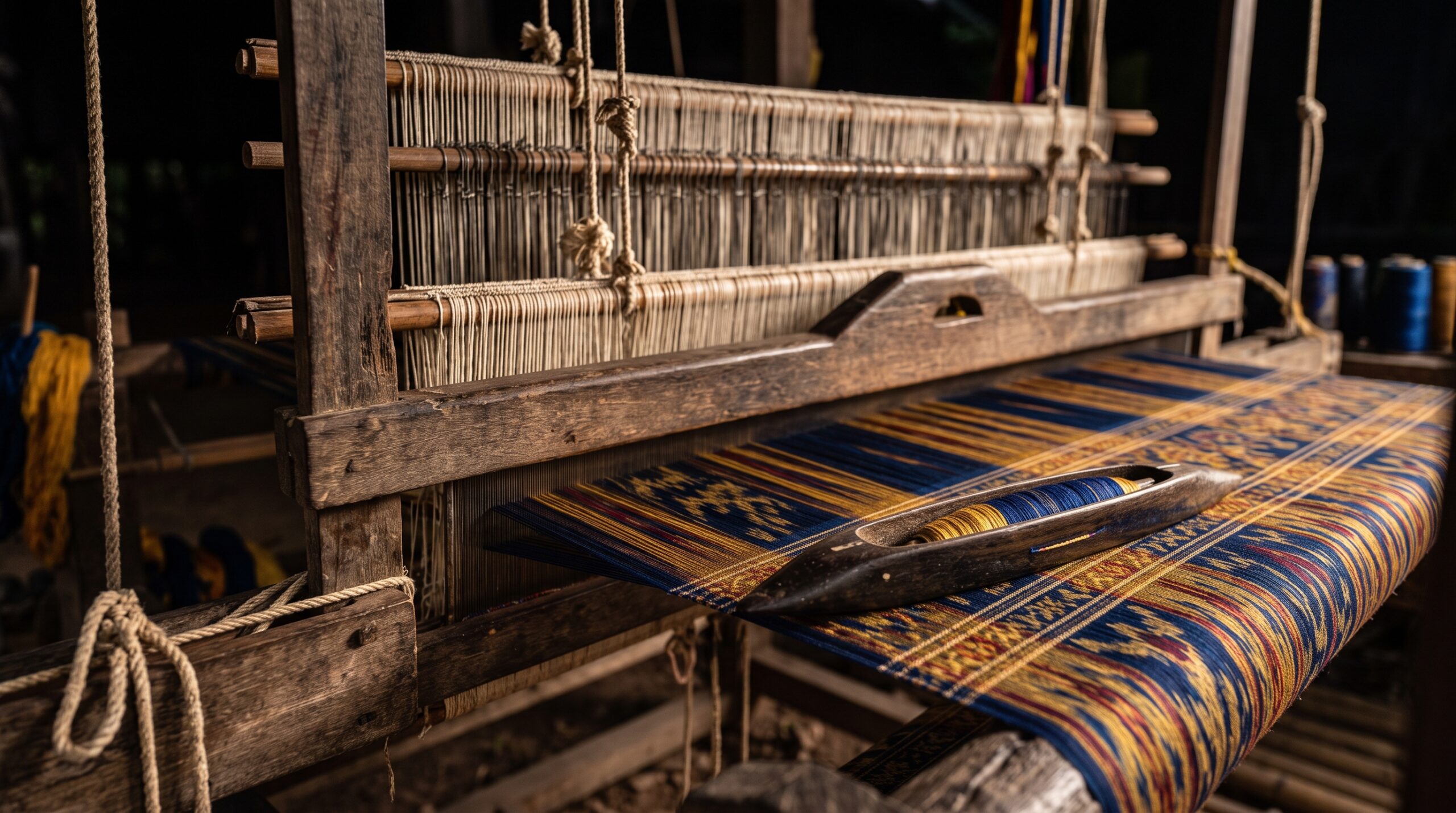
While fast fashion floods global markets with disposable synthetics, traditional Cambodian silk weaving remains an unbroken link to the golden age of the Angkor Empire. Master weavers sitting at creaking wooden floor looms continue to practice complex techniques like the hol (weft ikat) method, transforming raw silkworm cocoons into wearable masterpieces. Unpacking how this ancient craft survives, adapts, and captivates global admirers unlocks a stunning masterclass in heritage preservation.
The Ancient Roots and Royal Heritage of Khmer Sericulture
Tracing Threads Carved in Temple Stone
To understand the profound cultural significance of Cambodian silk, you must look beyond modern clothing racks and study the stone bas-reliefs of ancient temples like Angkor Wat and Bayon. Intricate garments carved onto twelfth-century celestial dancers (Apsaras) reveal that patterned silk skirts (sampot) have defined Khmer fashion and status for over a millennium.
Historically, sericulture—the breeding of silkworms and harvesting of silk—was an essential household art passed down from mothers to daughters in rural provinces like Takeo, Siem Reap, and Kandal.
Why Traditional Silk Production Stands Apart
Creating authentic Khmer silk requires an astonishingly labor-intensive, multi-step process that resists industrial shortcuts.
-
The Mulberry Foundation: Silkworms (Bombyx mori) feed exclusively on fresh mulberry leaves, requiring communities to maintain dedicated agricultural groves.
-
Natural Color Extraction: Artisans draw rich hues from organic sources, including insect nests for red, indigo plants for blue, ebony bark for black, and jackfruit wood for vibrant yellows.
-
Generational Transmission: The intricate coordination required to reel, spin, and dye thread is preserved entirely through oral tradition and hands-on community mentorship.
Expert Insight: Think of a traditional Cambodian silk textile as an analog hard drive. Every natural dye ratio and hand-tied knot encodes ecological wisdom and historical narratives that modern synthetic printing can never replicate.
Mastering the Art of Hol and Pidan Weaving
The Mind-Bending Precision of Weft Ikat
Among the most sophisticated techniques in the Cambodian textile canon is hol, the local term for weft ikat. Unlike printed fabrics where designs are stamped onto finished cloth, ikat requires weavers to tightly tie segments of silk thread with plant fibers before dyeing them.
This meticulous resist-dyeing process is repeated multiple times for different colors. When the threads are finally lined up and woven on a frame loom, intricate geometric, floral, and animal patterns emerge as if by magic.
Sacred Temple Tapestries: The Legacy of Pidan
Taking this technique to its highest artistic pinnacle is the pidan—a large, pictorial silk hanging traditionally woven as an offering to Buddhist pagodas.
-
Cosmological Narratives: Pidan cloths vividly illustrate Buddhist Jataka tales, mythical creatures, and multi-tiered representations of the universe.
-
Communal Merit-Making: Weaving a single pidan could take months or even years, serving as a sacred act of religious devotion and spiritual merit-making for the artisan.
-
Global Museum Treasures: Surviving antique pidan textiles are now prized centerpieces in prestigious international design institutions, showcasing the peerless geometry of Khmer master weavers.
Overcoming Tragedy: The Near-Extinction and Rebirth of an Industry
Surviving the Dark Chapters of History
The journey of Cambodian silk weaving has not been an easy, uninterrupted fairytale. During the devastating civil conflicts and the brutal Khmer Rouge regime of the late 20th century, sericulture was systematically banned, mulberry groves were burned, and master artisans were tragically displaced or silenced.
The specialized knowledge of producing high-end ceremonial textiles nearly vanished overnight, surviving only in the fading memories of a handful of elder survivors.
The Post-War Cultural Revival
Beginning in the 1990s and continuing through dedicated modern non-profit initiatives, a passionate coalition of cultural preservationists, NGOs, and local cooperatives stepped in to rescue the craft.
-
Village-Level Rehabilitation: Specialized centers on islands like Koh Dach (Silk Island) and in rural Takeo province rebuilt silkworm breeding programs from the ground up.
-
Empowering Female Artisans: Providing micro-loans and reliable fair-trade markets transformed weaving from a dying subsistence chore into a sustainable livelihood for thousands of rural women.
-
Pursuing Global Recognition: Modern cultural advocates are actively working toward securing international heritage protections to safeguard authentic Khmer weaving techniques for future generations.
The Economic Realities and Modern Challenges of Silk Weaving
Balancing Heritage Against Cheap Imports
Despite inspiring cultural revivals, contemporary Cambodian weavers face intense economic headwinds. The cost of locally produced raw silk often struggles to compete with cheap, mass-imported synthetic threads flooding in from neighboring countries.
Furthermore, younger generations drawn to urban factory work or digital gig economies sometimes view hand-weaving as grueling, low-margin labor.
Strategic Solutions for Sustainable Artisanal Futures
Protecting the long-term viability of Cambodian silk requires bridging traditional craft models with modern ethical consumer markets.
-
Traceability and Certification: Supporting transparent labels—such as fair-trade artisan cooperatives—guarantees that buyers pay premium prices that directly reward the weaver.
-
Eco-Tourism Integration: Inviting travelers to witness the silk-making process firsthand on rural farm tours creates vital secondary income streams for artisan families.
-
Government and Institutional Backing: Expanding tax exemptions on essential raw materials and funding local mulberry reforestation projects helps stabilize production overheads.
Expert Insight: When you purchase certified, authentically crafted Cambodian silk, you are not just buying a scarf or wall hanging; you are directly subsidizing the survival of an endangered living archive.
How to Identify and Care for Authentic Cambodian Silk
Spotting True Craftsmanship in the Marketplace
With countless synthetic knockoffs sold in tourist markets, learning to distinguish genuine hand-woven Cambodian silk is essential. Authentic silk possesses distinct physical characteristics that machines cannot replicate.
-
The Textural Test: Real hand-spun silk features subtle irregularities, slubs, and a characteristic dry, pleasant “squeak” when rubbed between your fingers.
-
The Burn and Weight Test: Natural protein fibers smell like burning hair when singed (unlike melting plastic synthetics) and drape with a fluid, weighted elegance.
-
Inspect the Reverse Side: In complex ikat (hol) weaves, the pattern bleeds slightly and appears with equal vibrancy on both sides due to meticulous hand-alignment.
Preserving Your Textile Treasures
Once you acquire a genuine piece of Khmer textile art, proper maintenance ensures it lasts for generations.
-
Gentle Washing: Hand wash delicate silk items in cold water using a mild, neutral soap rather than harsh chemical detergents.
-
Shaded Drying: Never wring out silk or expose it to direct harsh sunlight; instead, gently press out excess moisture in a clean towel and dry flat in the shade.
-
Low-Heat Ironing: Iron the fabric on a low setting (maximum 110°C) while slightly damp to maintain its crisp, luxurious sheen.
FAQ
1. What makes Cambodian silk unique compared to silk from other countries?
Cambodian silk is distinguished by its deep historical connection to Angkorian temple traditions, the intensive use of natural plant and bark dyes, and highly complex weft ikat (hol) techniques that create mesmerizing geometric and narrative patterns.
2. What is a pidan textile, and how was it used?
A pidan is a large, elaborately designed pictorial silk hanging traditionally woven by women as an offering to Buddhist temples, where it was suspended as a canopy over the main Buddha statue to depict sacred cosmological stories.
3. How has the Cambodian silk industry recovered from historical conflicts?
Following near-total destruction during the late 20th-century civil conflicts, the industry has experienced a powerful grassroots revival driven by non-profit organizations, village cooperatives, and government-backed mulberry farming initiatives that train new generations of weavers.
4. How can I tell if a Cambodian silk product is authentic?
Authentic hand-woven Cambodian silk features natural textural irregularities, a soft squeaking sound when rubbed, and complex double-sided patterns in ikat textiles, as opposed to the uniform perfection and chemical smell of synthetic knockoffs.
5. Where can visitors see traditional silk weaving in person in Cambodia?
Visitors can explore active silk-weaving communities and farm museums in rural Takeo province, Siem Reap, and Koh Dach (Silk Island) just outside Phnom Penh, where artisans demonstrate the complete process from cocoon to loom.
Conclusion
Cambodian silk weaving is far more than a commercial textile trade; it is a vibrant testament to the resilience, creativity, and spiritual depth of the Khmer people. By preserving ancient sericulture, mastering complex ikat dyeing, and supporting ethical village cooperatives, modern artisans continue to honor their ancestors. Invest in authentic hand-woven pieces, support local artisan communities, and wrap yourself in the living history of Cambodia’s textile masters.
Blog
This section provides an overview of the blog, showcasing a variety of articles, insights, and resources to inform and inspire readers.
-

The Lasting Influence of Jazz on Global Music Culture
You can go years without putting on a jazz playlist and still hear jazz everywhere.…
-

How Regional Food Traditions Continue to Shape American Identity
Order “barbecue” in one state and you get a vinegar-stained whole hog. Cross a state…
-
The Enduring Beauty of Cambodian Silk Weaving Traditions
You touch a length of hand-woven Cambodian silk, and the fabric instantly feels different from…

Real Success Stories from Our Customers
This section explains the step-by-step process, helping users understand how to get started and make the most of the product/service.
How a Business Achieved Remarkable Growth
This case study highlights how a company solved challenges using our solution, leading to increased efficiency, higher revenue, and a better experience for their customers.


Achieving Long-Term Success with Smart Strategies
This case study explores how a company overcame obstacles, optimized its approach, and achieved outstanding results with a proven strategy.
Transforming Operations with the Right Solution
This case study showcases how a business leveraged our product or service to streamline workflows, reduce costs, and scale effectively.



Leave a Reply